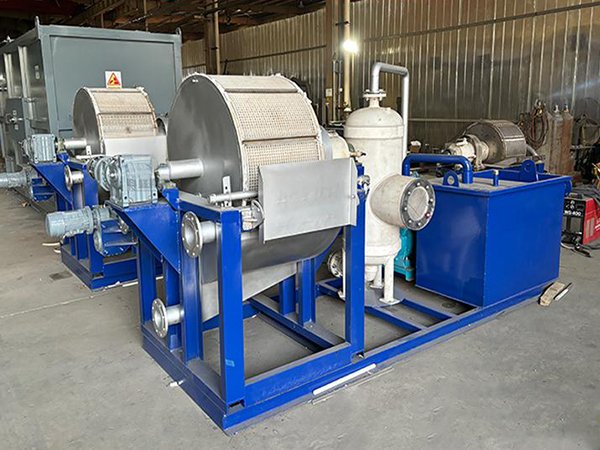
In process R&D for fine chemicals, biopharmaceuticals, new energy materials, environmental water treatment and other sectors, laboratory-scale solid-liquid separation is an essential pre-stage before industrial production.
R&D teams commonly face a major industry challenge: conventional small filtering devices only handle basic separation tasks. Test data obtained in the lab differs greatly from the operating conditions of full-scale production equipment. Processes proven feasible in lab trials cannot be directly applied to mass production, which delays R&D progress and raises costs for process commissioning and material trial runs.
The advent of the Bench Scale Rotary Vacuum Drum Filter has thoroughly addressed this challenge. It is now the preferred precision lab-scale solid-liquid separation equipment for R&D engineers and process procurement specialists. Fully replicating the core working principles and operational logic of industrial-grade rotary vacuum drum filters, it is the only lab device that enables a 1:1 scale-up from lab trial parameters to full industrial production. It delivers accurate and actionable data to support process validation, material testing and new product development.
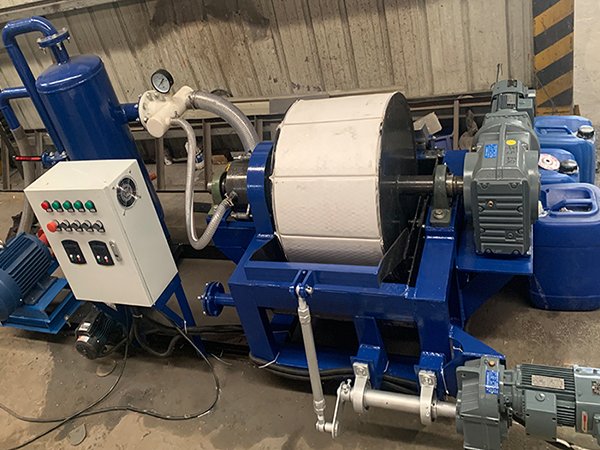
What is a Bench Scale Rotary Vacuum Drum Filter?
A Bench Scale Rotary Vacuum Drum Filter is a compact continuous solid-liquid separation unit engineered for scientific research, process development and formula validation. Unlike conventional batch-type lab filtration equipment such as vacuum filter flasks and small plate-and-frame filters, it adopts the structural design and working principles of large-scale industrial rotary vacuum drum filters. It consists of five core modules: filter drum, material tank, vacuum negative pressure system, automatic feeding system and material washing system, featuring a streamlined structure with full functionality.
This equipment is distinctly positioned from ordinary lab filters. While traditional lab filtration devices are mainly used for basic filtration and sample preparation, this unit focuses on process simulation, parameter verification and industrial condition replication. It performs solid-liquid separation tests for slurries, fermentation broths and powdered materials. More importantly, it simulates the operating conditions of continuous industrial production and generates accurate data for production equipment selection and process commissioning. It serves as a vital link connecting laboratory R&D and industrial manufacturing.
Working Principle of Bench Scale Rotary Vacuum Drum Filter
This equipment operates based on vacuum adsorption. With the continuous rotation of the drum, it realizes fully automated continuous processes including feeding and filtration, cake washing, vacuum dewatering, scraper discharge and filter cloth regeneration. It fully replicates the continuous filtration process for industrial production. Unlike batch operation of traditional devices, its working flow is highly consistent with actual mass production scenarios.
The complete operation consists of five steps:
- The bottom of the rotating drum is submerged in solid-liquid slurry inside the tank. As the drum rotates at a constant speed, negative pressure generated by the vacuum system draws liquid through the filter cloth, while solid particles adhere to the cloth surface to complete primary filtration.
- The drum keeps rotating, moving the cake-covered section out of the slurry. The washing system can be activated as required to spray and rinse the filter cake precisely, removing impurities and improving product purity.
- After washing, the vacuum system continues running for deep dewatering to reduce the moisture content of the filter cake.
- When the drum rotates to the discharge zone, the scraper automatically strips off the dewatered filter cake for material collection.
- After discharge, the filter cloth regeneration system cleans residual solids trapped in the cloth pores to restore permeability, and the system proceeds to the next filtration cycle.
The entire process requires no frequent manual intervention. Its continuous operation perfectly matches industrial production conditions. It fundamentally eliminates data deviation caused by traditional batch filters that fail to simulate continuous production processes, and ensures full consistency between lab techniques and industrial production processes.
Core Advantages of Bench Scale Rotary Vacuum Drum Filter
Nowadays, customers no longer focus solely on filtration performance. They also attach great importance to data accuracy, process compatibility and controllable R&D costs. These are exactly the core strengths of the Bench Scale Rotary Vacuum Drum Filter, as well as the key reasons why it replaces traditional laboratory filtration equipment.
1. Accurate Process Data
Core Strength
This unit fully replicates the operating principles and process logic of industrial rotary drum filters. Key parameters including drum speed, vacuum pressure, washing water flow and material submergence depth can be precisely adjusted and recorded in real time.
Test results such as filter cake moisture content, filtration flux, washing efficiency and material throughput can be directly adopted for industrial equipment selection and production parameter configuration. It effectively avoids the common industry issue of successful lab trials followed by failed mass production, and greatly shortens the cycle for process commercialization.
2. Simulate Continuous Industrial Production Conditions
Traditional laboratory filters operate in batch mode, with separate filtration and discharge for each cycle. They cannot replicate the continuous feeding, filtration and discharging seen in industrial production.
In contrast, the Bench Scale Rotary Vacuum Drum Filter can run stably for 24 hours a day to fully simulate real production scenarios. It enables accurate testing of material stability and changing filtration characteristics during continuous operation, delivering test results that closely reflect actual manufacturing conditions.
3. Fully Adjustable Parameters
The equipment supports fine-tuning of process parameters across multiple dimensions. According to the concentration, viscosity and particle properties of different materials, users can flexibly adjust drum rotation speed, vacuum pressure, spray flow rate for washing and material submergence depth. It caters to diverse research needs including new formula development, process optimization, extreme parameter testing and comparative tests under various working conditions, and is suitable for filtration experiments with all types of complex materials.
4. Low Material Loss
Designed with a fully enclosed structure, the equipment prevents material splashing and volatilization, minimizing waste of high-value materials widely used in biopharmaceuticals and fine chemicals.
Its streamlined structure leaves no dead corners for material buildup. The filter cloth is easy to remove, and the whole unit can be quickly cleaned and sanitized to eliminate cross-contamination between different batches and test materials. It fully meets the stringent cleanliness requirements for R&D in pharmaceutical and high-end fine chemical industries.
5. Easy Maintenance & Lower Long-Term R&D Costs
Built with a modular structure, the equipment has no intricate or fragile wearing parts. Filter cloth replacement, vacuum system upkeep and scraper adjustment are simple operations that can be performed independently by regular lab R&D staff.
Compared with sophisticated laboratory devices, it features lower after-sales costs and a reduced failure rate, delivering reliable long-term performance for high-frequency R&D trials.
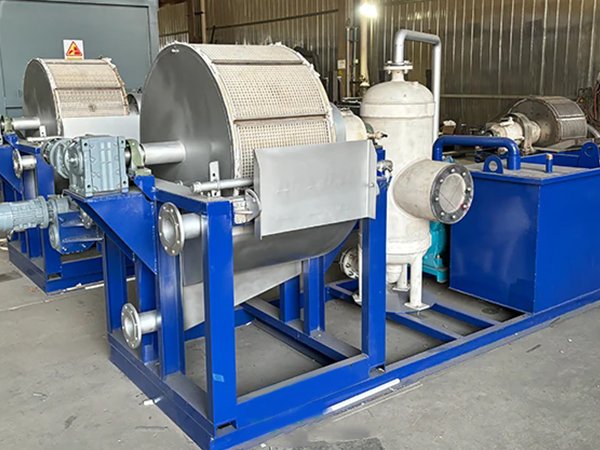
Equipment Comparison
Vacuum filter flasks and small plate-and-frame filters are the most common traditional devices for laboratory solid-liquid separation. However, both have notable limitations and fail to meet the requirements of advanced process R&D and industrial scale-up. The Bench Scale Rotary Vacuum Drum Filter delivers comprehensive performance upgrades.
vs. Vacuum Filter Flask
It adopts static batch filtration and only performs basic solid-liquid separation. Material washing and thorough dewatering are not achievable. Test data tends to be highly random, and the device cannot simulate continuous production conditions. Its experimental results are not applicable to industrial scale-up. It is only suitable for simple sample preparation and cannot support in-depth process development
vs. Small Plate-and-Frame Filter
While capable of batch filtration, it lacks continuous washing and continuous operation functions, with limited dewatering performance. Its operating conditions differ drastically from industrial rotary drum filters. The obtained parameters offer little reference value and cannot support R&D and validation for continuous production processes.
In conclusion, only the Bench Scale Rotary Vacuum Drum Filter features industry-matched processes, authentic continuous production simulation, practical parameters and reproducible test data. It is currently the sole solid-liquid separation laboratory device that bridges lab research and full-scale industrial production.
Core Application Industries & Compatible Materials
The Bench Scale Rotary Vacuum Drum Filter is suitable for solid-liquid separation tests and process R&D across diverse industries and material types. It is widely deployed in high-end research institutions and corporate R&D facilities. Its major application fields are listed below:
Biopharmaceuticals
Ideal for filtration, washing and dewatering tests of various fermentation broths, API intermediates, biological slurries and microbial biomass. It complies with the pharmaceutical industry’s strict standards for hygiene and cross-contamination prevention.
Fine Chemicals
Applied to solid-liquid separation and process optimization for catalyst powders, chemical intermediates, dyes and additives. It enables accurate verification of material filtration properties and production parameters.
New Energy Materials
Designed for R&D on filtration and dewatering of lithium battery materials, lithium iron phosphate, energy storage slurries and new powder materials, delivering reliable data to support mass production processes for new energy products.
Environmental Protection & Water Treatment
Conducts filtration and dewatering tests on industrial sewage sludge, flocculant slurries and wastewater sediments to optimize large-scale wastewater treatment solutions.
Food & Metallurgy
Used for separation tests on food raw material slurries and fine metallurgical mineral powders, meeting the material R&D and process validation requirements of these industries.
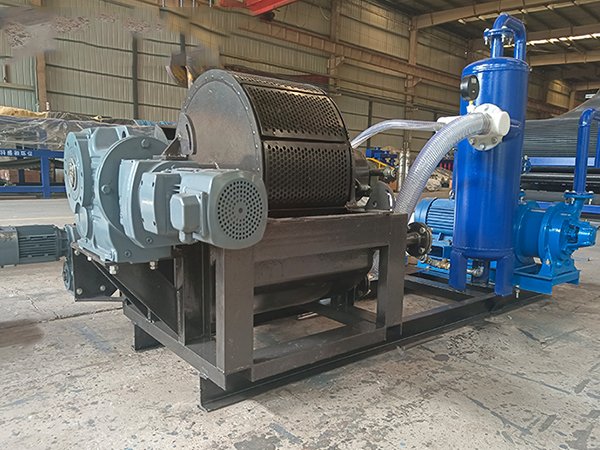
Core Technical Parameters & Custom Configurations
To meet the R&D standards for diverse industries and materials, the equipment allows precise parameter adjustment and personalized customization to satisfy varied customer requirements.
In terms of core parameters, the filtration area, drum rotation speed and vacuum pressure range are all fully adjustable. It suits small-volume and multi-batch experiments, featuring high adjustment accuracy and excellent test data stability. As for construction materials, the standard unit adopts 304 stainless steel. For tests involving acidic, alkaline or corrosive materials, it can be upgraded to 316 stainless steel or coated with anti-corrosion layers for special working conditions.
A wide range of optional configurations are also available, including automatic washing system, intelligent speed control system, enclosed dust-proof unit, explosion-proof assembly and data logging system. These add-ons enable automatic data storage and full-process traceability, complying with intelligent and standardized R&D requirements of high-end laboratories, pharmaceutical manufacturers and new energy enterprises.
Standard Operating & Maintenance Guidelines
Easy operation and low maintenance costs are key factors for equipment selection. Featuring a high degree of automation and standardized workflows, this unit requires no dedicated technical staff for routine operation.
Before tests, simply inspect the tightness of the vacuum system and the installation of filter cloth, then set parameters for drum speed, vacuum pressure and washing. The equipment will run automatically afterwards. Upon completion, the built-in cleaning system can quickly flush the interior and remove residual materials on the filter cloth to prevent clogging caused by material solidification.
Routine maintenance only involves periodic checks on vacuum pipelines, scraper wear and filter cloth permeability. Filter cloth replacement and vacuum unit maintenance can be performed as needed, with no complicated procedures required. The equipment boasts a low failure rate. Minor issues such as partial clogging and uneven discharge can be diagnosed and resolved efficiently, greatly cutting down lab maintenance workload and after-sales communication costs.
Selection Guide for Bench Scale Rotary Vacuum Drum Filter
The core of equipment selection is to match your actual test scenarios and material properties, so as to avoid mismatches between equipment functions and R&D requirements.
1. Select based on material properties
For materials with high viscosity, high concentration, corrosiveness or high purity, prioritize models with anti-corrosion materials, precise parameter control and fully enclosed structure. Standard configurations are sufficient for ordinary powder and water-based slurries.
2. Select based on experimental purposes
Basic models are suitable for simple sample preparation. If your main goals include process development, industrial parameter verification and new formula optimization, opt for professional models with full parameter adjustability, data logging function and authentic production condition simulation.
3. Customize in line with industrial standards
Custom exclusive configurations are available to meet special requirements in pharmaceutical, explosion-proof, sanitary and other regulated industries. This ensures the equipment complies with relevant R&D specifications, and guarantees the compliance and validity of test data.
Against the backdrop of accelerated process R&D iteration, laboratory equipment is no longer merely for conducting tests, but for delivering accurate support to mass production.
Thanks to its industrial-matched processes, scalable data, realistic working condition simulation, wide compatibility and easy maintenance, the Bench Scale Rotary Vacuum Drum Filter fully addresses the drawbacks of conventional lab filters, namely distorted test data and unworkable production processes. It has become a key device for R&D teams in research institutes, fine chemical, biopharmaceutical and new energy sectors, providing solid technical and data support for solid-liquid separation process optimization and the commercialization of new products.